
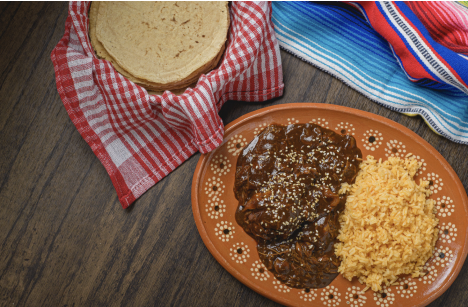
Ask ten people to describe mole, and you’ll probably get ten different answers: chocolatey,
spicy, smoky, fruity, savory, sometimes all at once. That’s not a contradiction.
It’s the entire point of mole! It’s a sauce built from dozens of ingredients, simmered for hours,
and layered with more complexity than almost anything else in Latin cooking.
If you’ve only ever heard mole compared to “Mexican chocolate sauce,” you’re missing almost
everything that makes it special.
So let’s answer the real question: what is mole sauce, exactly? And walk through where it came
from, what actually goes into it, and why one spoonful is enough to understand what all the
excitement is about.
Mole (pronounced “MOH-lay”) is a rich, thick sauce made from a long list of ingredients that
typically includes dried chile peppers, nuts or seeds, spices, dried fruit, and a small amount of
chocolate. The name comes from the Nahuatl word mōlli, meaning “sauce” or “mixture.” A fitting
name for a dish that’s less a single recipe than an entire category of sauce with regional
variations across Mexico.
What sets mole apart from salsa or adobo is sheer depth. A well-made mole can call for 20 to
30 individual ingredients, each toasted, ground, or simmered separately before coming together
into one sauce.
The result is a flavor that’s smoky, slightly sweet, a little spicy, and deeply savory all at once.
Which is exactly why it’s considered one of the most technically demanding dishes in Mexican
cuisine.
Mole’s origin is part history, part legend, and the two are so tangled together that even Mexican
food historians debate where the truth ends and the folklore begins.
The most famous story places mole’s creation at a convent in Puebla during the colonial period.
According to legend, nuns learned an archbishop was coming to visit and, having almost
nothing in their pantry, threw together whatever scraps they had (chiles, spices, stale bread,
nuts, and a bit of chocolate) into a sauce, then killed an old turkey to serve it over. The
archbishop loved it, and when asked what it was called, the nun supposedly replied, “I made a
mole.” It’s a charming story. However, most food historians agree it’s more folklore than fact.
The more likely explanation is that mole descends from mōlli, a chile-based sauce indigenous
peoples in Mesoamerica were already making well before Spanish colonization, using native
ingredients like chiles, tomatoes, and ground seeds. When Spanish colonizers introduced
chocolate, almonds, and spices from the Old World, those ingredients merged with existing
indigenous techniques to create the layered, complex sauce we recognize today. Either way,
Puebla and Oaxaca both proudly claim the title of mole’s true birthplace, and the debate has
never fully been settled.
mole contains chocolate, and the ones that do use it as a background note, not the star flavor.
Mexico has dozens of regional mole varieties, but a few stand out:
● Mole poblano — the most internationally recognized style, from Puebla. It’s dark
reddish-brown, built on a base of dried chiles like ancho and pasilla, and rounded out
with a small amount of chocolate, giving it a deep, slightly sweet undertone beneath the
smokiness.
● Mole negro — from Oaxaca, this is the darkest and most intense of the moles, often
incorporating charred chiles and a longer cooking process for an almost smoky-bitter
depth.
● Mole verde — a bright, herbaceous green mole made with tomatillos, pumpkin seeds,
and fresh herbs like cilantro and epazote, with none of the chocolate or dried-fruit
sweetness found in darker moles.
● Mole rojo and amarillo — red and yellow variations that lean more directly into chile
flavor, often with less complexity than poblano or negro but no less punch.
Every region, and often every family, has its own version, which is part of why mole is
considered less a single recipe and more a living tradition passed down over generations.
Here’s where mole earns its reputation as the most labor-intensive sauce in Mexican cooking. A
traditional mole poblano typically includes several categories of ingredients, each contributing
something different:
● Dried chiles (ancho, pasilla, mulato, guajillo) — the flavor backbone, providing
smokiness and gentle heat
● Nuts and seeds (almonds, sesame seeds, pumpkin seeds) — for richness and a subtle
nutty depth
● Dried fruit (raisins, prunes) — for a background sweetness that balances the chiles
● Aromatics (garlic, onion, tomato) — for savory depth
● Spices (cinnamon, cloves, cumin) — for warmth
● A small amount of chocolate — just enough to round out the bitterness of the chiles,
not to make the sauce taste like dessert
Every ingredient is toasted or roasted individually to bring out its full flavor before everything is
ground down and simmered together. Sometimes for hours. It’s a genuinely demanding process,
which is exactly why mole is traditionally reserved for special occasions: weddings, holidays,
and family gatherings where the time investment matches the significance of the meal.
Given all that, it’s easy to see why most people experience mole a handful of times a year, if
that. Who has hours to toast chiles and grind spices on a Tuesday night? But that scarcity is
exactly what makes mole so special every time you do taste it. It’s not a sauce you get tired of,
because most people never get the chance to have it often enough to.
That’s also exactly why we built our Chicken Mole Burrito Bowl: tender dark-meat chicken
simmered in a traditional mole sauce served over rice and black beans with a sprinkle of queso
fresco.
It’s the kind of dish people usually save for a special occasion, ready in minutes, any night you
want it.
If mole has never made it onto your plate, you’re missing one of the most genuinely unique
flavors in all of Latin cooking, there’s really nothing else quite like it. It doesn’t taste like “spicy
chocolate,” and it doesn’t taste like a typical enchilada sauce either. It’s smoky, warm, layered,
and a little bit mysterious in the best way, which is exactly why people who grew up eating mole
talk about it the way others talk about a grandmother’s secret recipe.
The good news is you don’t need a special occasion, a full afternoon, or a shopping list of 25
ingredients to finally taste it. Our Chicken Mole Burrito Bowl delivers that same rich,
slow-simmered flavor with none of the prep.
Browse our full lineup of ready-to-eat Latin meals, grab a Chicken Mole Burrito Bowl, or find
Cantina Latina near you and see what centuries of tradition taste like in a single bite. If you’ve
been curious, this is your sign to stop waiting.
We're Live! Serving up bold Latin flavors, made for busy lifestyles!